In One Minute
TL;DR
- Confirmations measure how deep a transaction is in blockchain history. Each new block added on top is one confirmation.
- They exist because very recent blocks can still be replaced or reordered, so extra blocks make that less likely.
- Finality is the point where the network treats the current history as locked in and no longer expected to change.
- A transaction can be confirmed without being final. Confirmations increase confidence; finality settles history.
- More confirmations increase confidence, but confirmations alone are not always the same thing as guaranteed finality.
- If you understand confirmations vs finality, you understand when blockchain history can be trusted.
Core Definitions
In everyday blockchain use, confirmations are a simple count. Once a transaction is included in a block, each new block added on top of it is one more confirmation.
The deeper a transaction sits under newer blocks, the more confirmed it is. This depth makes it harder for the network to switch to a different version of recent history that does not contain that transaction.
Finality is about reaching a point where the network no longer expects that part of the history to change. Past that point, the order and content of those blocks are treated as fixed.
A transaction can be confirmed without being final. Confirmations show progress toward stability; finality is the point where history is treated as locked.
Key facts
Confirmations
The number of blocks added on top of the block that contains a transaction. More confirmations mean the transaction is deeper in blockchain history and harder to change.
Finality
The point at which the network treats a part of blockchain history as settled and no longer expected to change under normal conditions.
Why Blocks Can Change After They’re Created
A newly created block is not like a page in a printed book. It is more like a draft chapter in a shared online document that several people are editing at the same time.
Imagine a group writing a shared story. Two people write the next chapter at once, each continuing from the same previous chapter. For a short time, some readers see version A and others see version B.
The group eventually agrees which chapter to keep as the official next one. The other chapter is discarded, and any changes inside it are either moved or lost. On a blockchain, this temporary situation is called a fork, and it can cause recent blocks to be replaced.
During this process, the order of very recent transactions can shift. That is why the latest blocks behave like drafts, and older blocks feel more like published chapters.
This is why very recent blocks are fragile, while older blocks feel stable.
Consensus rules are what decide which version of recent history survives these short forks.

What Confirmations Actually Measure
When a transaction first appears in a block, it has zero confirmations. As new blocks are added on top of that block, the confirmation count increases: one confirmation, two confirmations, and so on.
You can picture this as stacking bricks. Your transaction sits in one brick, and each new brick on top makes it harder to remove or replace the one underneath without disturbing the whole stack.
In blockchain terms, more confirmations mean that changing this part of history would require rewriting more recent blocks. That becomes increasingly difficult and costly. Confirmations do not change the transaction itself — they change how costly it would be to replace it.
Confirmations therefore measure growing confidence, not absolute certainty. They tell you how unlikely it is that the network will switch to a different recent history that does not include your transaction.

From Confirmations to Finality
As confirmations increase, the network’s view of recent history becomes more stable. A transaction that has just appeared may still move, but one buried under many blocks is very unlikely to change.
Some blockchains treat a transaction as effectively final after it has reached a certain number of confirmations. Past that point, the chance of reversal is so small that users and applications treat it as permanent.
Other blockchains use explicit signals to mark finality. Instead of only counting confirmations, the system marks certain blocks as final, and any transactions inside those blocks are then considered locked in.
Both approaches aim at the same outcome: a clear point after which history is no longer expected to change.
Pro Tip:Many wallets and apps hide the complexity by choosing a confirmation count or waiting for a finality signal on your behalf. What you usually see as “completed” is their chosen point on the path from first confirmation to finality.
What Finality Does — and Does Not — Guarantee
Finality is narrow but powerful. It means that the network has settled on a specific history: which transactions are included and in what order, up to a certain point.
Once a transaction is inside that final history, the network is not expected to reorder it, remove it, or replace it with a different transaction — under the system’s normal operating assumptions. Applications can rely on that ordering when updating balances or other records.
People sometimes assume that finality also guarantees things like a good price, protection from scams, or that the software has no bugs. Finality does not cover any of that.
It simply says: given the current rules, this part of the ledger is fixed. It does not judge whether the transaction was wise, fair, or safe in a broader sense.
Case Study: When “Done” Isn’t Final Yet
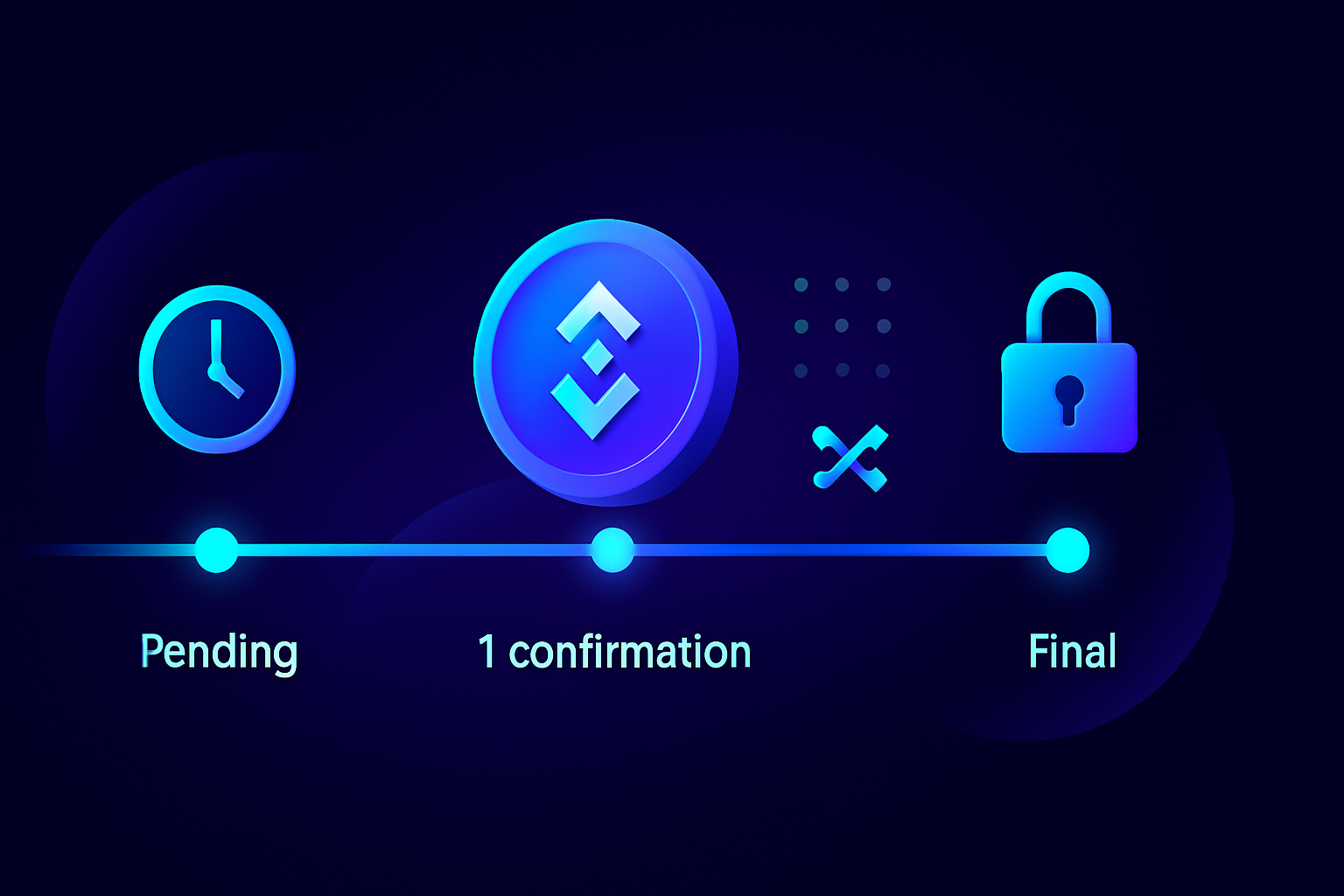
Anna sends crypto to a friend to pay for a concert ticket. Her wallet first shows “pending,” then quickly updates to “1 confirmation.” Relieved, her friend hands over the ticket, assuming the payment is done.
A few minutes later, Anna opens her wallet again and is confused: the transaction has disappeared from the latest block view. It looks as if it never happened, even though they just checked it.
Shortly after, the transaction reappears in a newer block. This time, Anna waits as the confirmation count climbs: two, three, four, and more. Her wallet eventually marks the payment as fully completed.
What happened behind the scenes was a brief reordering of very recent blocks. By waiting for more confirmations, Anna allowed the transaction to move from a fragile, changing part of history into the part that the network treats as final.
The lesson: wallets show progress, but only finality defines when history stops changing.
Mental Model (Key Takeaway)
A simple way to remember this is as a four-step flow.
First, transactions propose changes to the shared ledger: who sent what to whom. They are like suggested edits to a shared document.
Second, blocks collect and order these transactions, turning a pile of suggestions into a clear sequence.
Third, confirmations are the extra blocks that stack on top, increasing confidence that this ordering will not change.
Fourth, finality is the moment when the network effectively closes the book on that part of history and stops expecting any changes there.
Confirmations increase confidence. Finality settles history.
- Transactions propose changes.
- Blocks order transactions.
- Confirmations increase confidence.
- Finality settles history.
Where This Leads Next
This chapter closes the beginner one-hour overview. You have seen how individual transactions become part of blocks, how blocks link into a chain, and how that chain forms a shared history.
Here, you added the final pieces: confirmations as a measure of how settled a transaction is, and finality as the point where history stops being expected to change.
More advanced tracks explore how different blockchain designs actually achieve confirmations and finality. For now, you have the mental model needed to understand how blockchain history is created, ordered, and stabilized at a high level.
At this point, you understand the full lifecycle of blockchain history — from proposal to permanence.