What Is Mining in Crypto and How It Works?

Beginners and intermediate users worldwide who want to understand what crypto mining is, how it works technically and economically, and whether it’s relevant for them.

When many people hear "crypto mining", they picture a computer quietly printing free money in the background. In reality, mining is a competitive process where machines secure a blockchain, validate transactions, and earn rewards for doing so. Instead of a central bank, proof-of-work networks like Bitcoin rely on miners to agree on which transactions are valid and in what order. Miners spend real resources – mainly electricity and hardware – to solve cryptographic puzzles, and the network rewards the winner with newly created coins and fees. In this guide, you’ll learn why mining exists, how it works step by step, what kinds of hardware are used, and where rewards actually come from. We’ll also cover risks, environmental debates, mining vs. staking, and how to decide whether mining is a serious opportunity for you or better treated as a learning experiment.

Quick Snapshot: What Crypto Mining Really Is

Summary

  • Mining secures proof-of-work blockchains by making it expensive to attack or rewrite transaction history.
  • Miners earn income from block rewards (new coins) plus transaction fees paid by users.
  • Most profitable mining today is done by specialized operations with cheap electricity and efficient ASIC hardware.
  • Main costs are electricity, hardware purchase, cooling, and sometimes hosting or facility expenses.
  • Beginners usually mine as a small hobby or learning project, not as a main income stream.
  • For many users, regularly buying crypto or earning it through work is simpler and less risky than starting a mining operation.

Why Mining Exists and Why It Matters
Blockchains like Bitcoin are global ledgers that anyone can use, but no single company or government controls them. The network still needs a way to agree on which transactions are valid, in what order they happened, and to prevent the same coins from being spent twice – this is the consensus problem. Mining solves this by turning security into a competition. Miners bundle pending transactions into blocks and race to solve a cryptographic puzzle. The first miner to find a valid solution earns the right to add their block to the blockchain and receive a block reward plus transaction fees. Because solving these puzzles requires significant computing power and electricity, attacking the network would be extremely expensive. Honest miners are financially incentivized to follow the rules, while dishonest behavior risks losing their investment. This is why, even if you never mine yourself, miners are crucial to the trust and reliability of proof-of-work cryptocurrencies you might use or accept as payment.
Article illustration
How Mining Secures Networks
  • Validate and order transactions into blocks so everyone shares the same transaction history.
  • Provide security by making it costly to alter or censor the blockchain.
  • Issue new coins in a predictable way, replacing the role of a central bank in creating money.
  • Distribute newly created coins to miners who invest in hardware and energy, aligning incentives.
  • Help the network remain decentralized by allowing many independent miners to participate.

How Crypto Mining Works Step by Step

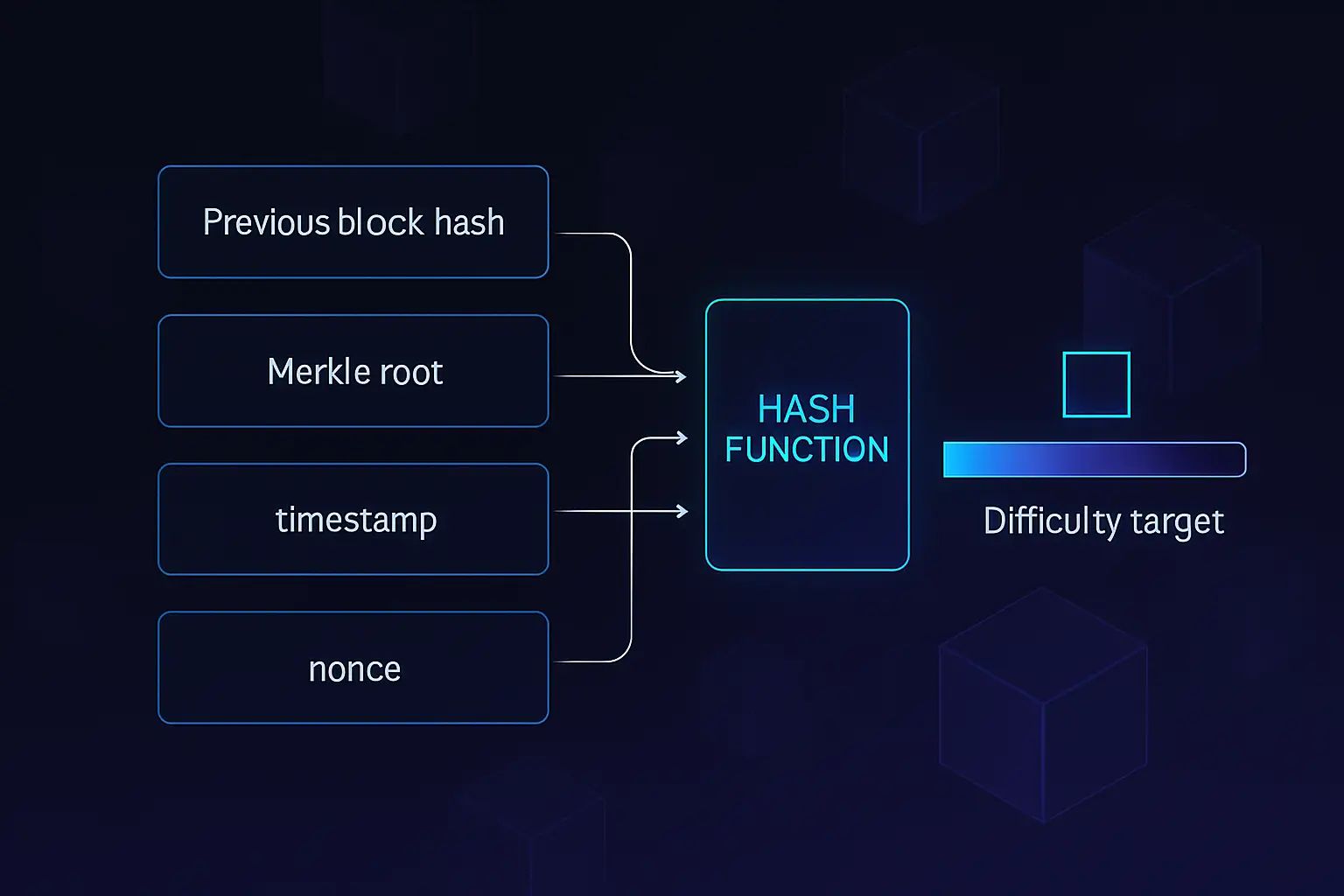
In a proof-of-work system, miners compete in a kind of lottery. Each miner takes the data for a candidate block and runs it through a cryptographic hash function again and again, changing a small value called the nonce each time. The goal is to find a hash that is below a target number set by the network. There is no shortcut: miners simply try billions or trillions of combinations per second. The first miner to find a valid hash wins the right to broadcast their block, and if the network accepts it, they receive the block reward and fees.
  • Users send transactions, which are checked by nodes and placed into a shared pool of pending transactions called the mempool.
  • A miner selects transactions from the mempool, usually prioritizing those with higher fees, and builds a candidate block.
  • The miner hashes the block header repeatedly, changing the nonce and other small fields, until the resulting hash meets the network’s difficulty target.
  • The first miner to find a valid hash broadcasts their block to the network for verification.
  • Other nodes independently verify the block’s transactions and proof-of-work; if valid, they add it to their copy of the blockchain.
  • The winning miner receives the block reward and collected transaction fees, while everyone else starts working on the next block.
Article illustration
Inside The Mining Puzzle
If miners add more computing power to the network, they can find valid hashes faster. To keep blocks arriving at a steady pace (around 10 minutes for Bitcoin), the protocol automatically adjusts the difficulty of the puzzle. Every set number of blocks, the network looks at how long the last period took. If blocks were found too quickly, it raises difficulty, making the target hash harder to hit; if they were too slow, it lowers difficulty. This feedback loop keeps block times relatively stable over years, even as hardware and total hashrate change dramatically.

Mining Hardware and Typical Setups

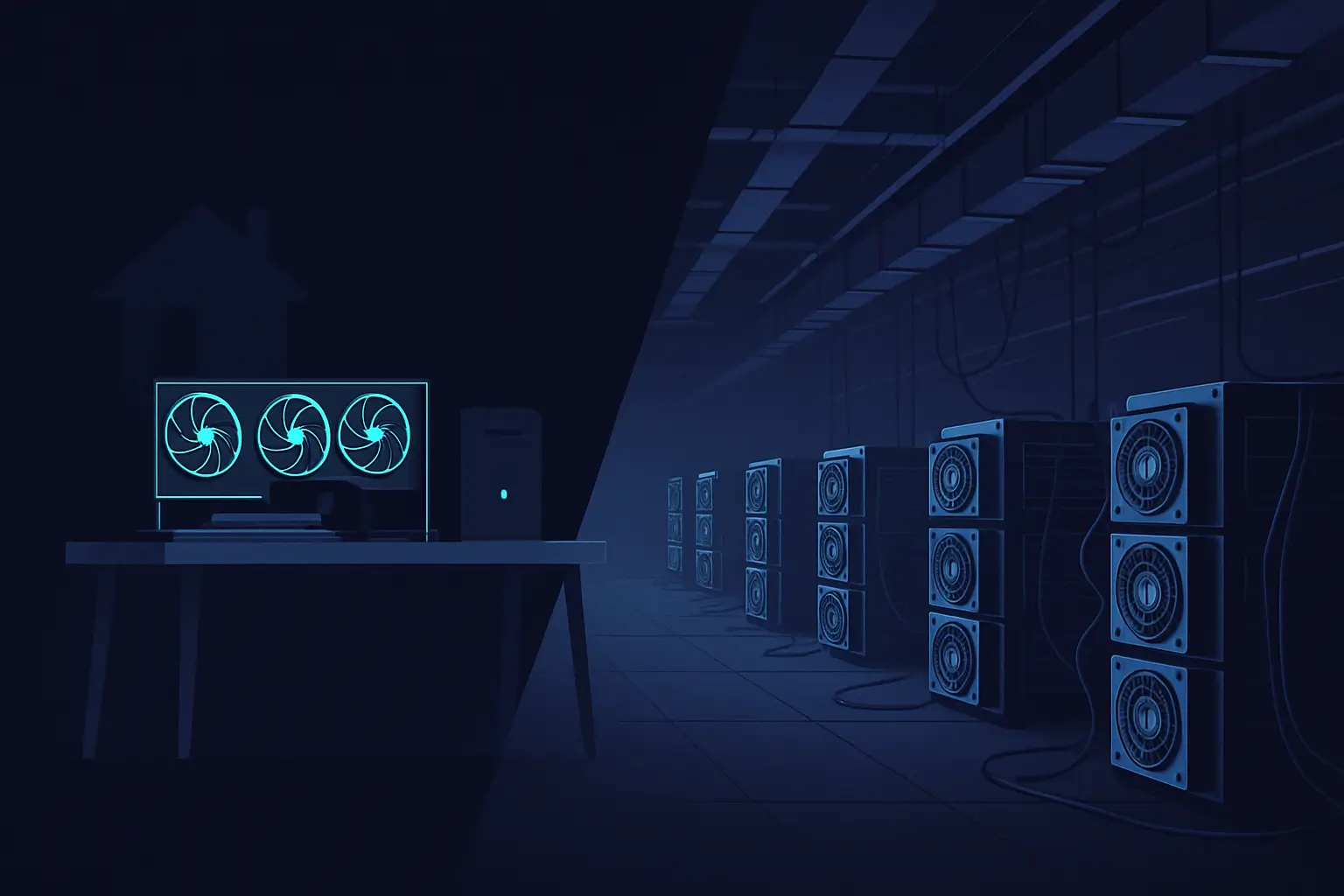
In Bitcoin’s early days, anyone could mine on a normal computer CPU and still find blocks. As more people joined, competition increased, and miners switched to more powerful GPUs (graphics cards) that could perform many hashes in parallel. Eventually, companies built ASICs – chips designed only for mining a specific algorithm like Bitcoin’s SHA-256. ASICs are far more efficient than CPUs or GPUs, but they are expensive, noisy, and quickly become obsolete as difficulty rises. This arms race means that for major coins like Bitcoin, most profitable mining now happens in industrial-style farms, not on home laptops or gaming PCs.

Key facts

CPU mining
Very low hashrate, poor energy efficiency, usually not profitable on major coins; mainly used for experiments or niche algorithms.
GPU mining
Moderate to high hashrate on some algorithms, better efficiency than CPUs, flexible (can mine multiple coins), but still limited vs ASICs.
ASIC mining
Extremely high hashrate and best efficiency for a specific algorithm, high upfront cost, loud and hot, standard for industrial Bitcoin mining.
Article illustration
From Rigs To Farms
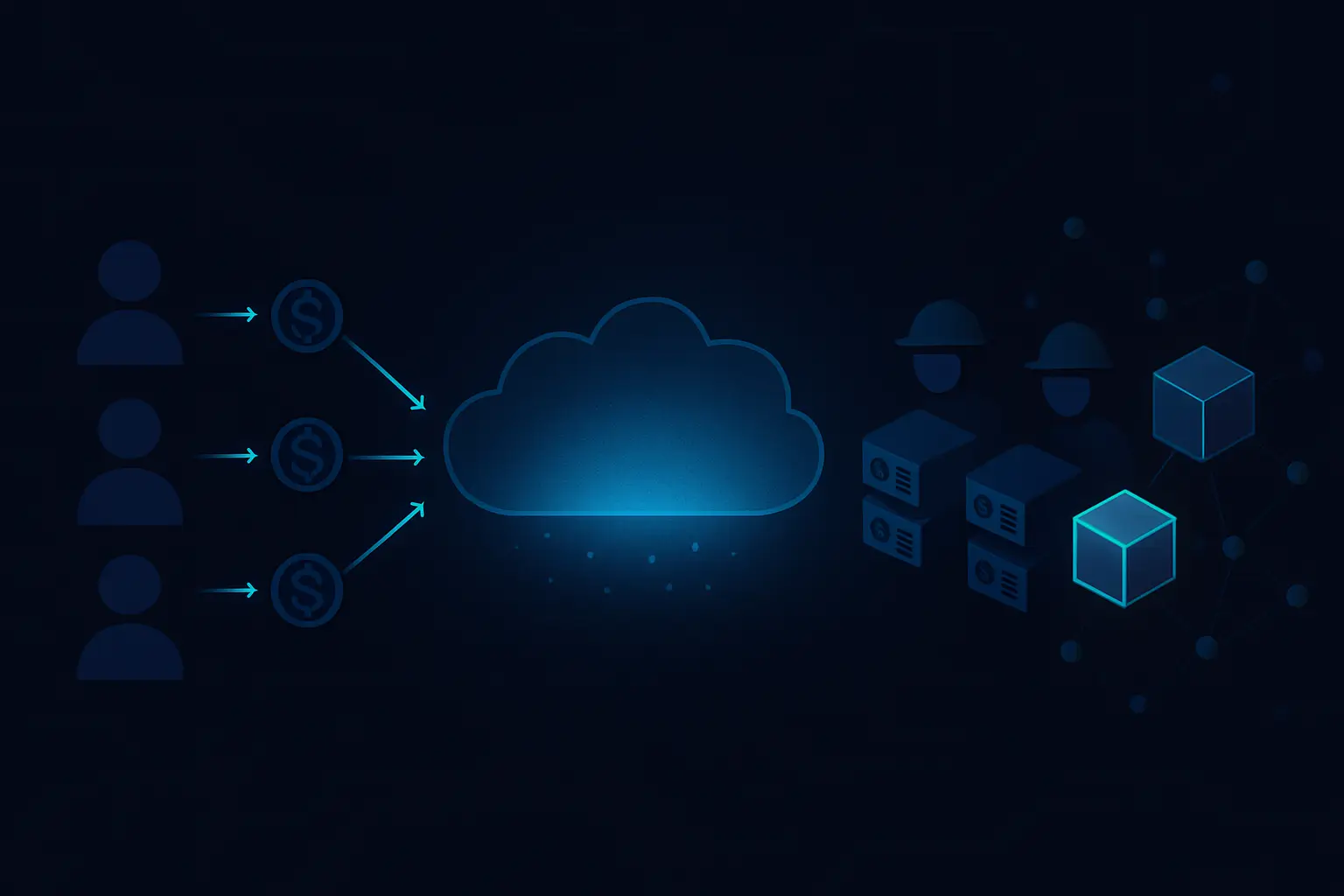
Some companies offer cloud mining, where you rent hashrate instead of buying hardware. While this sounds convenient, it is a high-risk area filled with scams, hidden fees, and contracts that often become unprofitable when difficulty or prices change. If you consider cloud mining at all, treat every offer with extreme skepticism, research the provider’s history, and compare expected returns to simply buying and holding the coin instead.

Mining Rewards, Halvings, and Profitability Basics

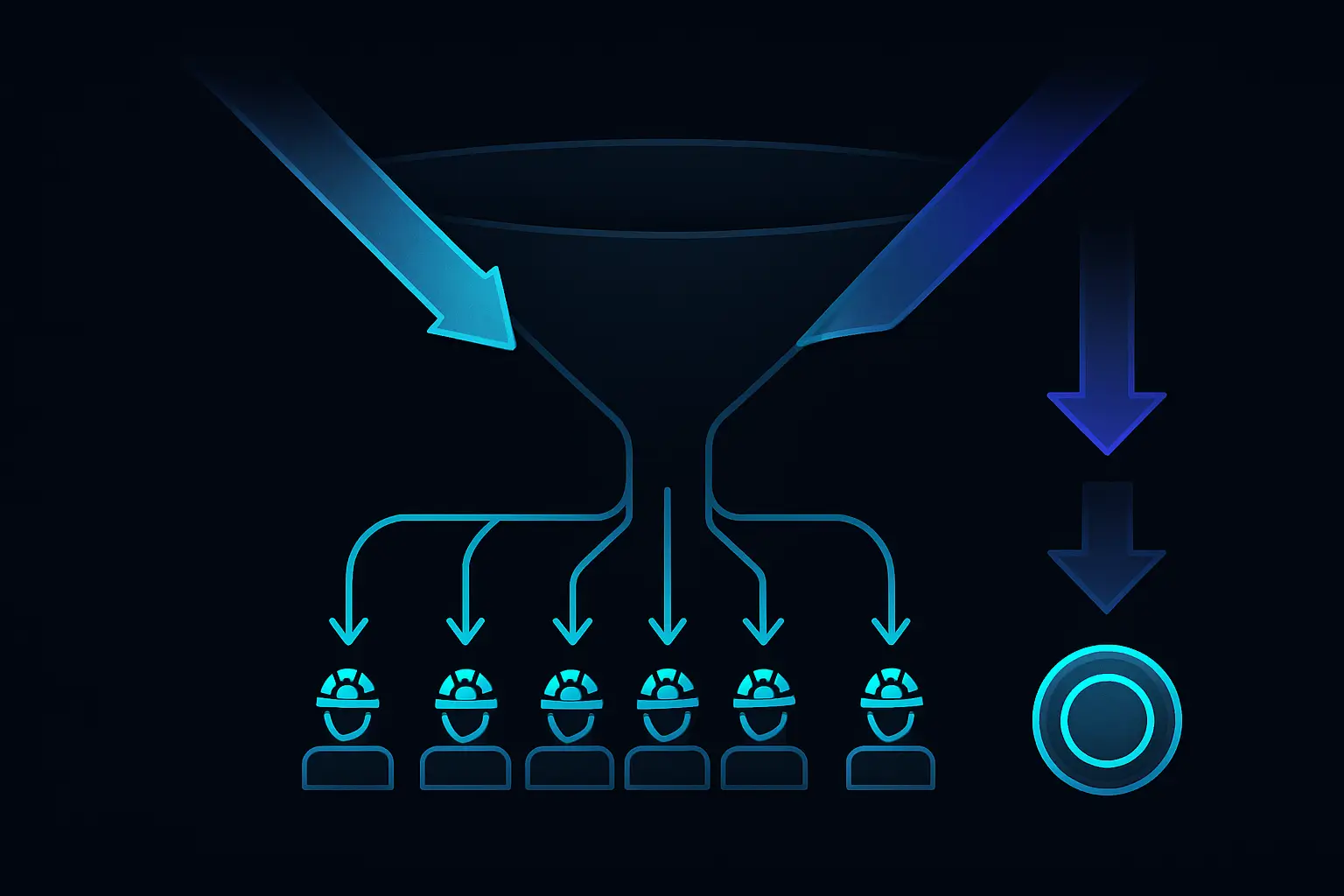
Miner income has two main parts: the block reward (newly created coins) and the transaction fees included in that block. In Bitcoin, the block reward started at 50 BTC and is programmed to drop by half roughly every four years in events called halvings. Over time, halvings reduce new coin issuance, making Bitcoin more scarce if demand stays the same or grows. As block rewards shrink, transaction fees are expected to play a larger role in miner revenue. For individual miners, this means profitability can change dramatically around halving events and during bull or bear markets.
  • Market price of the coin you are mining (revenue is paid in that asset).
  • Current block reward size and average transaction fees per block.
  • Network difficulty and total hashrate, which determine how often your hardware finds shares or blocks.
  • Energy price per kWh and overall power consumption of your setup.
  • Hardware efficiency, purchase price, and expected lifetime before it becomes uncompetitive.
  • Pool fees, hosting fees, and other operating costs that reduce your net payout.
Article illustration
From Rewards To Profit
Online mining calculators can help you estimate potential profits, but they rely on assumptions that may change quickly. Coin prices, difficulty, and fees can all move in ways you do not expect. Treat any profitability estimate as a snapshot, not a guarantee. Always stress-test your numbers with lower prices, higher difficulty, and rising electricity costs before spending serious money on hardware.

Mining Pools vs. Solo Mining

Mining is probabilistic: even if your hardware is powerful, there is no guarantee when you will find a block. A small solo miner might statistically expect to find one block every few years, but in reality it could happen sooner or much later. To reduce this variance, most miners join mining pools. In a pool, many miners combine their hashrate and share rewards whenever the pool finds a block. This usually means smaller, more frequent payouts instead of rare, large ones.
  • Solo mining offers full control and no pool fees, but payouts are extremely irregular and often unrealistic for small hashrate.
  • Pool mining provides more stable, predictable income by sharing rewards across many participants.
  • Pools charge a small fee (often 1–3%) on rewards to cover their infrastructure and services.
  • Large pools can become a centralization risk if they control a big share of network hashrate.
  • Solo miners must run full node infrastructure and handle all configuration themselves, while pools simplify setup with easier software and dashboards.

Case Study / Story

Diego, a 29-year-old IT technician in Brazil, kept seeing YouTube videos about people making passive income with crypto mining. With his hardware skills, he imagined filling his spare room with rigs and paying his rent from Bitcoin rewards. Before buying anything, he ran numbers through several mining calculators. Using his local electricity rate and the price of new ASICs, the results were disappointing: most scenarios showed tiny profits or even losses if Bitcoin’s price dropped. He realized that without very cheap power, competing with industrial farms would be hard. Instead of giving up, Diego bought a modest second-hand GPU rig and joined a mining pool for a smaller proof-of-work coin. His payouts were small but steady, and his power bill increased more than he expected, forcing him to fine-tune settings and improve cooling. After a year, he was roughly break-even in fiat terms, but he now understood difficulty, hashrate, and pool mechanics in depth. Diego decided to keep one small rig running as a learning hobby and focus his serious investments on simply buying and holding crypto.
Article illustration
Diego’s Mining Journey

Who Actually Mines and Why

Today, most hashrate on large proof-of-work networks comes from specialized mining farms with thousands of ASICs and access to cheap power. These operations treat mining like a full-scale industrial business with professional cooling, maintenance, and risk management. Hobbyists and small miners still exist, but they usually operate in niches: regions with surplus or very cheap electricity, smaller PoW coins, or educational setups. Even if you never mine, you benefit from these participants because they help keep the network secure and decentralized.

Use Cases

  • Large industrial farms colocated near hydro, wind, or gas power plants to minimize electricity costs.
  • Small GPU hobby miners who treat mining as a technical hobby and a way to accumulate small amounts of crypto over time.
  • Operations in regions with surplus or stranded energy, such as remote hydro stations or flared natural gas sites.
  • Multi-coin GPU miners who switch between different proof-of-work coins based on short-term profitability.
  • Educational setups in universities or at home, used to teach how blockchains and consensus work in practice.
  • Experimental eco-friendly mining projects using only renewable energy or capturing waste heat for heating buildings.
  • Miners focusing on niche PoW blockchains where their hashrate significantly contributes to network security.

Energy Use, Environment, and Regulation

Proof-of-work mining consumes significant energy because miners constantly perform intensive computations to secure the network. Critics argue that this creates a large carbon footprint, especially when electricity comes from fossil fuels, and that this energy could be used for more directly useful tasks. Supporters counter that mining can help absorb surplus or stranded energy that would otherwise be wasted, such as excess hydro or flared gas. In some regions, miners deliberately seek out renewable sources to lower both costs and emissions. The real impact depends heavily on the local energy mix, regulations, and how quickly the industry shifts toward cleaner power.
  • Public debate focuses on mining’s energy use and associated greenhouse gas emissions, especially in coal-heavy grids.
  • Some miners are moving toward renewables or using otherwise wasted energy to reduce both costs and environmental impact.
  • Several countries and regions have restricted or banned large-scale mining due to energy strain or environmental concerns.
  • Regulatory pressure has pushed miners to relocate across borders, reshaping where hashrate is concentrated globally.
  • Major projects like Ethereum have migrated from proof-of-work to proof-of-stake to reduce energy consumption.

Risks, Security, and Common Pitfalls in Mining

Primary Risk Factors

Mining may look like a straightforward way to earn crypto, but it carries real financial, technical, and security risks. Individuals can lose money on hardware, face rising electricity bills, or fall for fraudulent cloud-mining schemes. At the network level, mining also shapes security. Concentration of hashrate in a few pools or regions can increase the risk of censorship or a 51% attack, where an attacker controls a majority of mining power and can manipulate recent transactions.

Primary Risk Factors

Profitability risk
Revenue can drop quickly if coin prices fall, difficulty rises, or fees decrease, turning a once-profitable setup into a loss.
Hardware obsolescence
ASICs and GPUs can become uncompetitive within a few years, leaving you with expensive equipment that earns little or nothing.
Electricity price changes
Increases in power tariffs or removal of subsidies can erase your profit margin overnight.
Regulatory and policy risk
New rules, taxes, or outright bans on mining in your region can force you to shut down or relocate.
Cloud mining scams
Many cloud-mining offers are Ponzi schemes or hide fees; you may never recover your initial investment.
Pool failure or hacks
Mining pools can suffer outages, mismanagement, or security breaches, delaying or reducing your payouts.
51% and centralization risk
If too much hashrate concentrates in a few hands, they could censor transactions or reorganize recent blocks on the network.

Security Best Practices

  • Start with a small, low-cost setup or even a mining simulator, and track real-world earnings and expenses for a few months before committing serious capital.

Mining vs. Staking and Other Consensus Methods

Not all cryptocurrencies are mined. Many newer networks use proof-of-stake (PoS) or other consensus mechanisms that do not rely on energy-intensive mining. In PoS, participants lock up coins as "stake" and are chosen to create blocks and earn rewards based partly on how much they have staked. Compared with proof-of-work, staking usually requires much less energy and no specialized hardware, but it concentrates power among those who already hold large amounts of the coin. Mining, by contrast, turns electricity and hardware into security, allowing participants to join by investing in equipment rather than the asset itself.
  • PoW mining costs are dominated by hardware and electricity; PoS costs are dominated by the capital you lock as stake.
  • PoW has a larger energy footprint, while PoS is more energy-efficient but concentrates influence in large holders.
  • In PoW, an attacker needs massive hashrate; in PoS, they need a large share of the total staked coins.
  • Small users may find it easier to join PoS via staking pools or exchanges than to run competitive mining hardware.
  • Bitcoin and Litecoin are major PoW coins; Ethereum, Cardano, and Solana use proof-of-stake or similar systems.

Home Mining vs. Industrial Mining at a Glance

Key Value Hashrate Home: very low, a few devices; Industrial: extremely high, thousands of ASICs contributing significant network share. Electricity cost per kWh Home: standard residential rates, often high; Industrial: negotiated wholesale or on-site energy deals, usually much lower. Hardware pricing Home: retail prices, limited discounts; Industrial: bulk purchases with better pricing and direct manufacturer relationships. Uptime and maintenance Home: occasional downtime, limited monitoring; Industrial: near-constant uptime with dedicated staff and monitoring systems. Cooling and noise Home: basic fans, noise and heat affect living space; Industrial: engineered cooling systems, noise isolated in dedicated facilities. Regulation and permits Home: usually minimal, but may face landlord or building rules; Industrial: zoning, environmental rules, energy contracts, and inspections. Risk diversification Home: concentrated in a few machines and one location; Industrial: diversified across many devices, sites, and sometimes multiple coins.

Common Beginner Mistakes in Crypto Mining

Many new miners focus on screenshots of big payouts and forget that those numbers come with serious costs. They buy hardware first and only later realize how much electricity, heat, and noise they have invited into their home. Avoiding a few common mistakes can save you money and frustration, even if you only mine as a small hobby or educational project.
  • Not calculating total cost of ownership, including hardware, electricity, cooling, and potential repairs over the device’s lifetime.
  • Ignoring heat and noise, then discovering that mining rigs make rooms uncomfortably hot and loud.
  • Trusting unverified cloud mining offers that promise high returns with no risk or clear business model.
  • Failing to secure mined coins by leaving them on pool or exchange wallets instead of using safe self-custody options.
  • Running hardware 24/7 without monitoring temperatures, leading to premature failure or even safety hazards.
  • Misunderstanding tax or reporting obligations on mined coins in their country, which can create problems later.
  • Assuming past profitability charts will repeat, instead of stress-testing numbers against lower prices and higher difficulty.

FAQ: Crypto Mining for Beginners

Should You Get Into Crypto Mining?

May Be Suitable For

  • Technically inclined users with access to cheap, reliable electricity
  • Hobbyists who want to understand proof-of-work and are comfortable with small or zero profits
  • People who already own suitable GPUs and want to experiment safely
  • Learners who value hands-on experience more than short-term returns

May Not Be Suitable For

  • Anyone expecting guaranteed passive income or quick profits
  • People with high electricity prices or strict housing rules about noise and heat
  • Users who are not willing to monitor hardware, safety, and taxes
  • Investors who simply want price exposure and have no interest in running equipment

Miners are the backbone of proof-of-work blockchains, turning electricity and hardware into security, transaction validation, and predictable coin issuance. Without them, networks like Bitcoin could not function in a decentralized, trust-minimized way. However, modern mining is a competitive industry dominated by players with cheap power, efficient ASICs, and professional operations. For most individuals, especially with average or high electricity prices, mining is unlikely to be a reliable profit engine. If you have a strong technical interest, access to low-cost energy, or spare hardware, a small mining setup can be a valuable learning tool. If your main goal is financial exposure to crypto, regularly buying, earning, or staking coins is usually simpler and less risky than trying to build a mining business from scratch.

© 2025 Tokenoversity. All rights reserved.