Is Hyperliquid Safe?
How your funds stay under your control - and what risks actually exist in practice
Understand how safe Hyperliquid is in a few minutes
- Understand who controls your funds
- See what risks are removed vs centralized exchanges
- See what new risks you take on
- Decide if this model fits you
Most traders find the risk lower than expected once they understand how it works.
Follow the Quick Start -> first trade in ~10-15 minutes
Already familiar with trading?Open Hyperliquid directly
Non-custodial
You keep control

Transparent & verifiable
Everything is on-chain

You stay in control
You manage your funds
What "safe" actually means in crypto
When people ask if an exchange is safe, they're usually not thinking about technical details.
They're asking something simpler:
On centralized exchanges like Binance, the answer is yes - and it has happened many times.
Hyperliquid works differently - and that changes the risk model completely.
The key distinction is simple:

Understanding this difference explains most of the risk.


 CORE PRINCIPLE
Who actually controls your funds
On Hyperliquid, you do. There's no account, no balance stored on a company server, and no internal ledger that someone can modify.
When you deposit, your funds are locked in a smart contract, and only your wallet can authorize moving them.
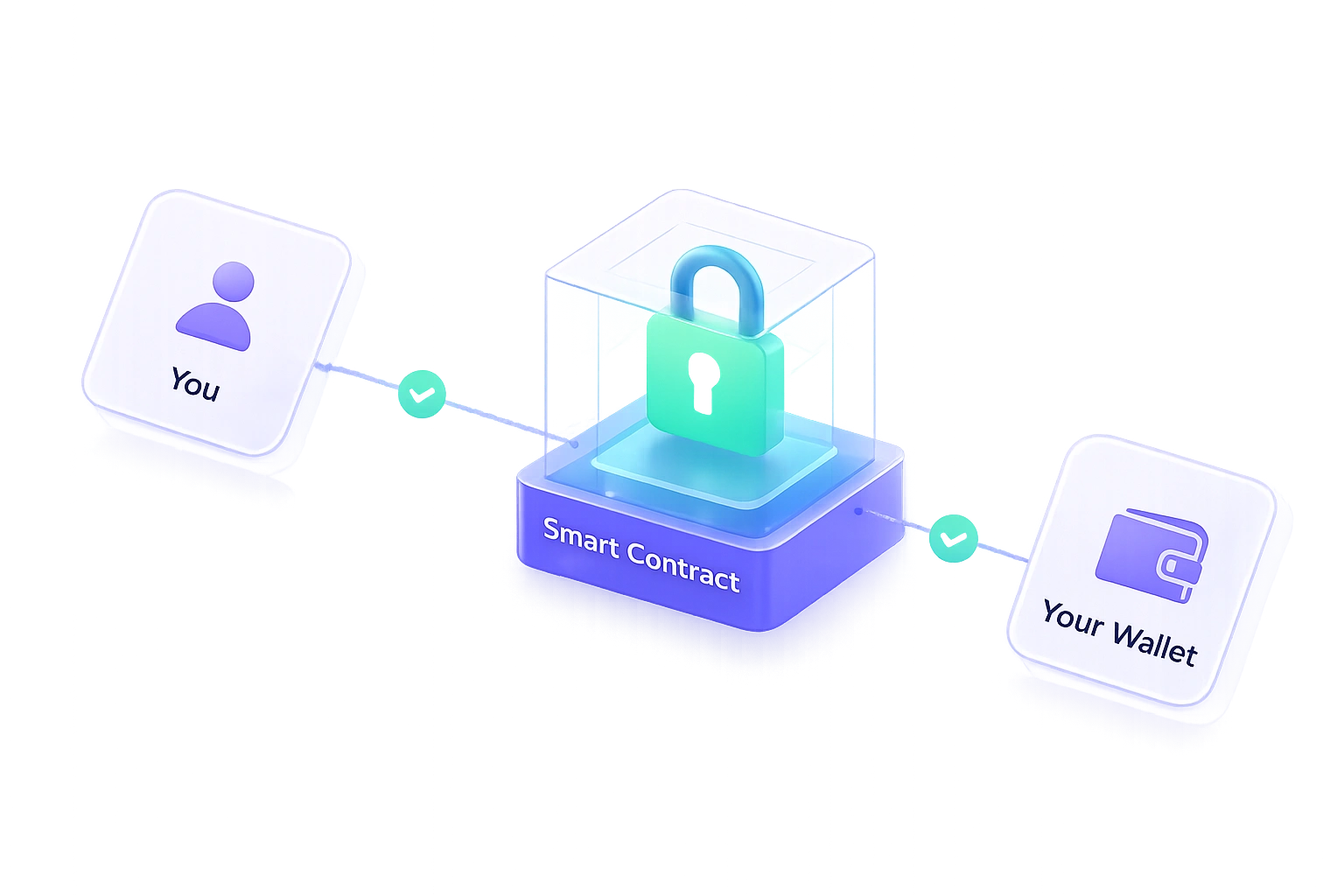
And importantly: If Hyperliquid's frontend disappeared tomorrow, your funds would still be accessible directly through the contract.
That's a very different kind of safety than most traders are used to.
This is the core of Hyperliquid's safety model.
Why this matters (and where CEXs fail)
Most problems traders face on exchanges are not technical - they're structural.
On centralized platforms, users regularly run into:


This is not a system failure. In a centralized model, the platform can restrict withdrawals, accounts, or access under its own rules, because it holds the funds and controls access.
And this happens more often than most people expect.
But "safe" does not mean "risk-free"
Hyperliquid removes one major category of risk: the risk that comes from relying on a centralized company. But that does not mean trading becomes risk-free. Instead, the risk model changes.
There is no company that can freeze your account, block withdrawals, or restrict access. At the same time, there is also no company that can reverse mistakes or recover access if something goes wrong.
In simple terms, platform-level risk is reduced, but personal responsibility increases.


- Your funds are controlled by code instead of a company. If there were a critical bug, it could affect users.
- In practice, these systems are public, actively used, and continuously observed. But the risk exists, and it is important to understand that.

- This is the biggest shift for most users.
- On a centralized exchange, you can forget your password, contact support, and recover access.
- On Hyperliquid, that layer doesn't exist.
- There is no password reset, no support ticket, and no recovery email.
- If you lose access to your wallet, you lose access to your funds.
- If you sign the wrong transaction, it executes instantly.
- This is the trade-off for having full control. For most users, this is the biggest shift compared to centralized exchanges.

- Many people confuse platform safety with trading outcomes.
- But losing money on a trade has nothing to do with whether the exchange itself is safe.
- High leverage, volatility, and poor risk management exist everywhere - both on CEXs and DEXs.
- Hyperliquid doesn't increase that risk.
- It simply doesn't protect you from it either.
Hyperliquid vs Binance (risk model)
The difference becomes clear when you look at it side by side:
| Risk type | Hyperliquid | Binance |
|---|---|---|
| Custody | You control funds | Exchange controls funds |
| Withdrawals | Always available | Can be paused |
| Account risk | None | Can be restricted |
| KYC exposure | None | Required |
| Smart contract risk | Yes | No |
| Company risk | Minimal | High (custodial) |
For most traders, this is the real comparison - not features, but risk models.
What most traders actually do
In practice, people do not fully switch from centralized exchanges. They split roles:

use a centralized exchange to buy crypto

move funds to Hyperliquid
trade there
How to stay safe (in real terms)
You don't need a complex security setup. A few simple rules cover most real-world scenarios:
The bottom line
Hyperliquid is not risk-free.
But it removes the risks that actually wipe traders out.
There are no account freezes, no withdrawal blocks, and no sudden KYC requirements.
What replaces them is responsibility instead of dependence.
For many traders, that trade-off is worth it because it puts them back in control.
That's the Hyperliquid model.
You are ready to decide
At this point, you understand how safety works on Hyperliquid - and what risks actually exist.
Want to understand more before starting?